
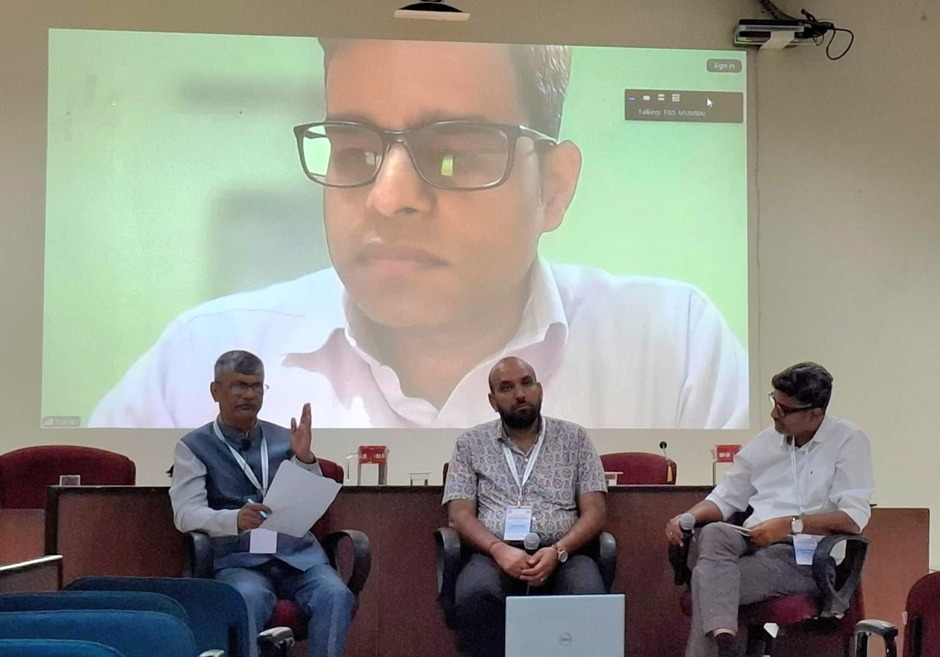
The South Asian Conference on Policy Advocacy and Social Entrepreneurship, held on 13–14 February 2026 at TISS Mumbai, convened leading scholars, practitioners, policymakers and ecosystem leaders to critically examine the role of social entrepreneurship in shaping public policy across South Asia.
Organised by the Centre for Social Entrepreneurship, TISS Mumbai, in partnership with the Society of Entrepreneurship Educators (SEE), Institute Innovation Council (IIC), and TISS Incube Foundation, the conference created a platform for rigorous dialogue at the intersection of grassroots innovation and governance systems.
Social Entrepreneurship in the Policy Process
A highlight of the conference was the panel discussion titled “Social Entrepreneurship in the Policy Process,” moderated by Satyajit Majumdar, Managing Director, TISS Incube Foundation.
The distinguished panel included:
1. Abhishek Bhati, Associate Professor of Political Science, Bowling Green State University (BGSU), Ohio, USA
2. Raviraj Durwas, Senior Programme Manager, Climate & Nature Fund, Hindustan Unilever Limited
3. Pranav Kumar, IPS, Additional Commissioner of Police, Kolkata, West Bengal
From Innovation to Policy Influence
The discussion foregrounded a critical shift: social entrepreneurship is no longer confined to service delivery — it is increasingly influencing how policy is imagined, tested, and implemented.
The panelists emphasized that social enterprises:
1. Surface systemic gaps through deep community engagement
2. Pilot innovative, context-specific models
3. Generate actionable field evidence that can shape policy decisions
Rather than operating at the margins, social enterprises function as strategic bridges — connecting communities, institutions, markets, and state systems.
Designing Policy for Impact and Adaptability
A central insight from the dialogue was the need for balanced policy design. While clarity and standards are essential for accountability and coordination, excessive rigidity can constrain innovation and limit responsiveness across diverse geographies and sectors.
The panel called for:
1. Context-sensitive policymaking
2. Cross-sector collaboration
3. Clearly defined and measurable social impact frameworks
Aligning grassroots innovation with policy advocacy, speakers noted, enables scalable and sustainable development outcomes.
Addressing Structural Inequality and Sustainability
The audience interaction deepened the conversation around structural inequality, highlighting that disparities extend beyond extreme poverty to include economically vulnerable working families alongside concentrated wealth. Speakers emphasized that policy reform must focus on equitable distribution of resources, rather than attributing responsibility solely to individuals. The environmental consequences of high-consumption lifestyles were also examined, with discussions around progressive taxation, regulatory frameworks, and sustainability-oriented governance mechanisms.
The session concluded with a strong reaffirmation: in democratic systems, policymaking is shaped by citizen participation, social movements, and grounded field evidence. Social enterprises play a vital role in informing governance by bringing community realities into policy discourse.